
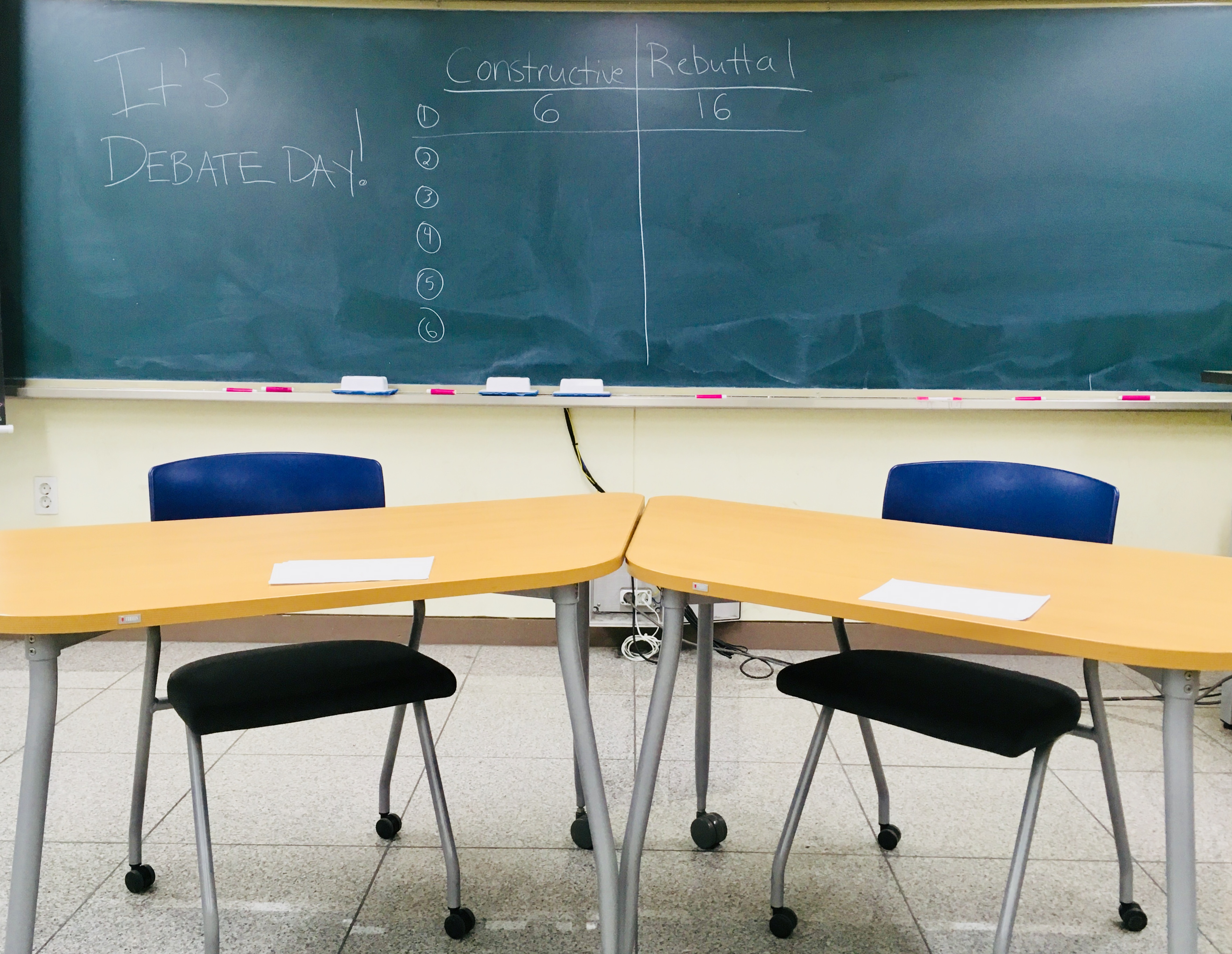
It’s almost time for students to pump their theme songs throughout the stadium, run down the aisle, and catapult themselves over the top rope into the savage melee of a Debate Royal Rumble. But not just yet.
Before we start our class debates, which will span three days (Days 6, 7, and 8), students will have one last day (today, Day 5) to spar with their opponents. Today’s class serves two purposes: 1) to simulate a debate so students know exactly what to expect when assessments begin next session and 2) to give students a chance to work with their opponents to fortify their arguments – and even rehearse a bit if they have time.
I. Warm-up / Presentation (10-15 min)
- Set up the room exactly as it will be set up during class debates
- Two desks in front of room, with stacks of scrap paper on each
- Laptop with stopwatch timer in back of room (the timer should be easily visible to debaters who are sitting in the front of the room)
- Judge Cards on every student’s desk
- Make two columns on the board, one titled Constructive and one Rebuttal.
- After students settle in, write one student’s ID number or name under Constructive and another’s under Rebuttal (i.e. Student 6 vs. Student 16). Ask those two students to come sit at the debate desks.
- Give them the simulated resolution, which all students will recognize as the first resolution they ever saw in our class:
“Bicycles are a better form of transportation than cars.” - Hand out Bikes vs. Cars MODEL to all students including the debaters.
- Start the timer and tell students they can write notes for one minute.
- Because this is a simulation, students won’t actually write notes, but it’s still good for them to get a sense of what one minute feels like.
- Reset the timer, and have the Constructive speaker read from the model.
- It should take about 1:30-2 mins to read.
- Reset the timer, and give the Rebuttal speaker one extra minute for notes.
- Reset the timer, and have the Rebuttal speaker read from the model.
- Tell students that this is the end of our debate, and students in audience should mark their judge cards based on who made the best argument.
- Remind students:
1) We will have about 6-7 debates on each of our debate days.
2) No student will have more than one debate per day.
3) Everyone will be Constructive once and Rebuttal once.
II. Production (35-40 min)
- Have students sit next to their debate opponent and use the remaining class time to work on their arguments and rehearse their debates.
- Circulate and work with struggling students.
- For students who are having a hard time coming up with strong reasons to support their arguments, I’ve found one surefire way to help them is to encourage them to think about the argument from the perspectives of different people. Students tend to be stuck in their own little world, so they only think about arguments from their perspective. But it can be helpful to ask them, “What about a little kid?” or “What about a senior citizen?” or “What about a woman?” or “What about a man?” or “What about an immigrant?” or “What about a bus driver?” or “What about a parent?” or “What about a restaurant owner?” or “What about a teacher?”
- Wish students good luck on their debates, which will start next class, and remind students that debate is really just a game and an opportunity to show off their speaking skills – it’s okay to have some lighthearted or silly arguments in their speeches.
Materials:
– Judge Cards
– Bikes vs. Cars MODEL
– Dictionaries
*This post shows Days 5-8 of an 8-lesson series called “How I Teach Debate to English Learners”.
 Busan Teacher