

I. Warm-up (5)
- Seat students in 4 groups (of 5) in each corner of the room .
- Tell students you will explain the seating arrangement, but first we need to check our memories.
- Review some key vocabulary from last class by asking students to give the correct word for:
- our topic from last class – debate
- the statement people debate – resolution
- the side that agrees with the resolution – affirmative
- the side that disagrees with the resolution – negative
- the first speech – constructive
- the response speech – rebuttal
- the person who makes sure debaters follow the rules – moderator
II. Presentation (10 min)
- Tell students you are still considering all of the resolutions they submitted for our future class debates, and you will announce the resolutions next class.
- Give each group a large white board, dictionaries, and markers.
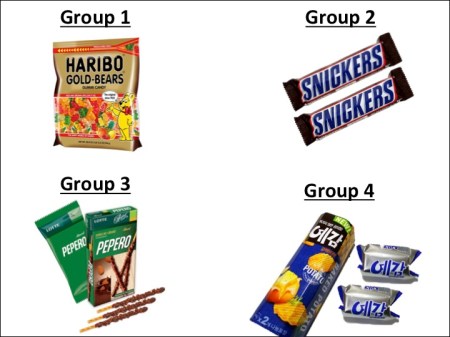
- Then give each group a snack and assign group numbers, using Snack Attack PPT, Slide 2:
- Direct students’ attention to the screen, showing them Slide 3:
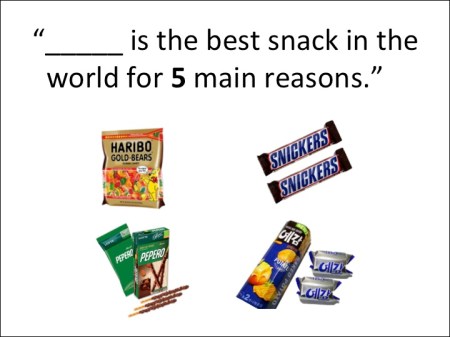
- Instruct students to consult with their groups and make a Top 5 list on their white boards. The list should consist of 5 reasons why their snack is the best.
- Tell students to focus on their snack’s unique qualities (taste, smell, size, shape, color, cooking method, nutrition, marketing, packaging, etc.) and not to compare to other snacks.
- Circulate and tell students they should be able to explain their reasons with support (examples, evidence, etc.).
- Some groups will shy away from opening the snack. If that happens, tell them: “If I had to explain why this was the best snack, I’d want to be an expert. And I think I’d have to try the snack to be an expert.”
- Eventually, a brave student will open the snack, and the other groups will follow suit like dominoes.
III. Production (30 min)
- When each group has created their list, they should choose one or two speakers (by rock-paper-scissors) to represent their group and share their argument, using their team whiteboard.
- The speakers should use the following script, on Slide 4 to make their cases:
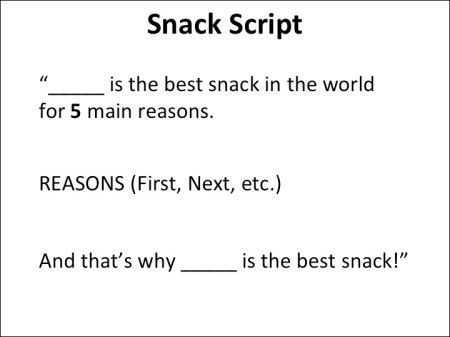
- The speakers should use the following script, on Slide 4 to make their cases:
- After each group has made their cases, tell students we are going to do a little judging practice.
- Group 1 should look at Group 2’s reasons and vice versa.
- Group 3 should look at Group 4’s reasons and vice versa.
- Each group must decide the two weakest reasons in their opponents arguments. Once decided, you should erase those reasons from each white board.
- Now, distribute the white boards to opposing teams.
- Give Group 1’s board to Group 2 and vice versa.
- Give Group 3’s board to Group 4 and vice versa.
- Give each group one additional, blank white board.
- Show them Slide 5:
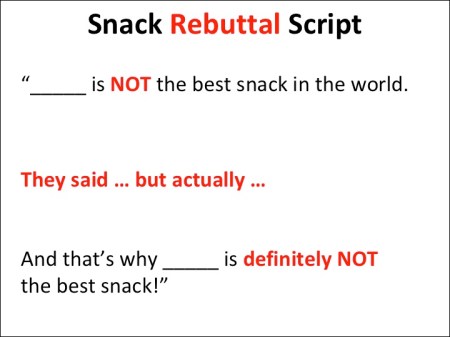
- Tell students that they have the 3 strongest reasons for their opposing team’s argument (they will bristle at this because they just removed the weakest arguments), and now their job is to rebut each reason.
- So, on their blank white board, students should rebut each of their opponent’s reasons, in list form.
- Then students should choose a new representative(s) to present their rebuttals. Tell Groups 1 and 2 they should pay extra attention to Groups 3 and 4 because they will vote on which team made the best arguments. Similarly, Groups 3 and 4 should pay extra attention to Groups 1 and 2.
IV. Voting and Wrap-Up (5 min)
- After each group has presented their rebuttal, have Groups 1 and 2 vote for the winner of 3 vs. 4. And have Groups 3 and 4 vote for the winner of 1 vs. 2.
- Reveal the votes and congratulate the winners.
- Point out to students that they have all just proven that they can successfully write and present both a constructive speech and a rebuttal speech.
Student Samples
Constructive Speech – Student Sample 1
Constructive Speech – Student Sample 2
Rebuttal Speech – Student Sample 1
Rebuttal Speech – Student Sample 2
Materials:
– Snack Attack PPT
– Snacks of your choice
– White boards and markers
– Dictionaries
*This is Day 3 of an 8-lesson series called “How I Teach Debate to English Learners”.
**This lesson was inspired by a lesson originally created by Mark Schneberger.

