
*This is Day 2 of a 3-lesson series called “How I Introduce Meditation to English Learners”.
Language Level: Intermediate/Advanced
Time: 50 minutes
I. Warm-Up (5 min)
Ask students to recall our topic from last class: meditation. With students in pairs, set timer for 2 minutes, and tell students to talk to their partner about everything they remember learning last class. The goal is to keep discussing with no silence for the full 2 minutes.
After 2 minutes, ask the whole class what they discussed, eliciting a few important points, like: meditation is mind-training, meditation helps with stress, meditation can change our brains, etc.
II. Andy Puddicombe and Mindfulness (25 min)
Hand out Andy Puddicombe Vocab, which students should review to prime for our first activity:

With students in groups of 2-4, hand out the jumbled strips, which come from the transcript of Andy Puddicombe’s TED Talk: “All it takes is 10 mindful minutes”:
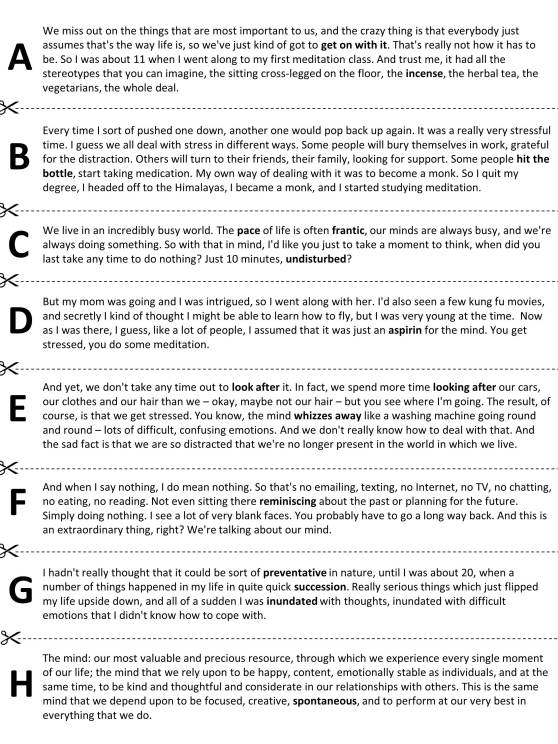
Have students try to arrange the strips in order, and see which group can do it correctly first.
After a couple teams solve the jumble, hand each team the transcript of the first part of the TED Talk, along with the comprehension questions. Have students complete the Pre-Watching questions:
1. What does Andy say that we spend more time looking after than our minds?
2. What stereotypes of meditation did Andy see when he first went to a meditation class? Who did he go with?
3. Name at least three ways that people deal with stress, according to Andy.
Watch first 3:43 of “All it takes is 10 mindful minutes” with English subtitles. Watch rest of video with Korean (L1) subtitles:

Discuss the Post-Watching questions as a whole class:
4. What is the meaning of the juggling balls; what do they represent?
5. Andy says that we can’t change every little thing that happens to us in life, but we can change the way we e________________________ it.
After eliciting ‘experience’ for No. 5 , tell students that one way to practice fully ‘experiencing’ our lives is to do a body scan meditation.
III. Body Parts and Body Scan (20)
Tell students that in order to do a body scan meditation in English, we have to make sure we know the names of various body parts.
Hand out Body Scan Vocab and have students attempt to complete. They can work in pairs or groups. After a few minutes, review each body part.
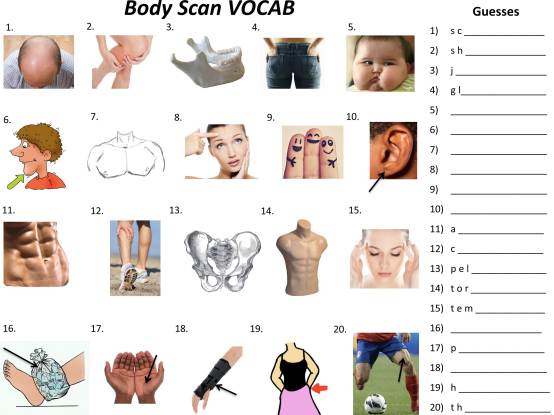
Tell students that to be sure they can identify each part, we are going to do a silly little activity to practice. Here’s how it works:
With everyone standing up, the teacher will either A)point to a body part or B)say a body part. When teacher points, students should shout out the body part. When teacher says a body part, students should touch that part on their own body. Play for about 3 or 4 minutes.
After the activity, tell students to have a seat, and prepare to listen carefully to the guided body scan meditation, which is only about 3 minutes.
Play the full body scan meditation audio from the Calm meditation app:

Upon completion of the meditation, tell students that this is a type of meditation they can do anytime they have a few minutes, and they don’t need any audio to do it. By paying attention to the sensations on our bodies, we are training our mind to pay attention to what is actually happening, which was our original definition of meditation.
 Busan Teacher