

The world of English education is obsessed with debate.
I am … not.
While there are certainly benefits to a debate curriculum, I think there can be plenty of drawbacks too. Debate can induce an unproductive amount of stress in students. It can overly emphasize winning and losing. It can encourage style over substance. Its time limits can be onerous. And debates can lack the flow of the real-world conversations our students so desperately want to participate in.
Keeping in mind some of these pitfalls for English learners, I created a series of classes that, I hope, harnesses the most advantageous parts of debate for intermediate ELLs and aims to bolster student confidence above all.
I teach debate to my high school students over eight, 50-minute class periods. In this post, I’ll share my lesson for Day 1. In future posts, I’ll share my lessons for the subsequent days so you can see how the lessons develop, build off one another, and culminate in a student-friendly speaking assessment.
Debate Day 1 – Debate in Disguise
Today’s lesson introduces students to impromptu speaking and begins to lay the foundation for their debate assessments. The word ‘debate’ is never brought up in this lesson because it is designed to prove to students that they are capable of the basic mechanisms of debating before saddling them with the pressure of a looming assessment.
I. Warm-up (5 min)
- Seat students in pairs.
- Write on board: “Let me tell you something about __________.”
- Show students a small stack of Apples2Apples cards, face down. Tell students if I choose their student number, they will draw a card and then complete the above sentence with the word or phrase on the card. They must then give a fact, an opinion, or a quick story about the word or phrase.
- Use class chopstick set to choose a student randomly. That student chooses a card and performs the speaking task. The same student then draws from the chopstick set to determine the next student, who will follow the same procedure as the first. Repeat with about 4-5 students, and occasionally ask follow-up questions to elicit more language.
Example:
Student: “Let me tell you something about picking your nose. People say that picking your nose is gross. But everybody does it – both kids and adults. Adults are just better at hiding it.”


II. Presentation (10 min)
- Write the word “impromptu” on the board and ask if anyone knows the meaning. Elicit the simple definition “without planning” or “without preparing”
- Ask the students who spoke during the warm-up if they knew before class that they’d have to talk about their word or phrase. They’ll answer no. Say, “So you didn’t have much time to prepare? You spoke impromptu.”
- Tell students they will watch a short video clip. While they watch, they should ask themselves, “Why is this an impromptu moment?
- Show the Michael Bublé – Singing With A Fan Live video.
(*Bublé uses some minor vulgarity.)- Students (humans!) love music, and this song is also pretty easy to understand – so it works on a few levels.

- Ask students to tell you what happened in the video. They should explain that Sam’s mom asked if he could go on stage because he just had a birthday and he loves to sing.
- Ask students, “Why is this an example of an impromptu moment?” They should say it was impromptu for Sam because he didn’t know he’d be called on stage. And it was impromptu for Michael Bublé because he hadn’t planned to call an audience member on stage.
- Tell students: “Now that we’ve seen some impromptu singing, let’s talk a bit more about impromptu speaking.”
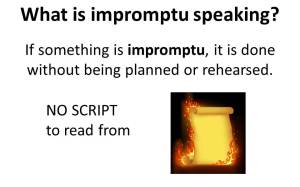
- Guide them through the Impromptu PPT through Slide 5.


III. Practice (20 min)
- At Slide 6 in the Impromptu PPT, explain to students that we will practice some impromptu speaking, following the instructions on the screen.

- Hand out blank scrap paper to each student and urge them to take some keyword notes as they watch.
- Show students two Mr. Bean cartoon videos:
- Assign one partner (the student sitting on the left) to be Student A and the other (the student sitting on the right) to be Student B .
- Tell all the Student A’s they will begin by telling their partner the story of the “Lovely Bubble Bath” video, speaking for 90 seconds without stopping. Then the Student B’s will tell the story of “Artful Bean” to Student A, speaking for 90 seconds without stopping.
- Set a countdown timer on the screen for Student A and begin, and then repeat for Student B. I like e.ggtimer.com.


- Circulate and monitor students’ successes and stumbling blocks.
- Congratulate students for speaking for 90 seconds without stopping and ask them how it was – easy or difficult? Most will say difficult.
- Elicit and clarify some key vocabulary from the students for each video:
- “Lovely Bubble Bath” – grater, hand mixer, hairstyle, yo-yo, stopper, drain
- “Artful Bean” – blender, scrape out, fungus, snorkeling mask, deodorizing spray
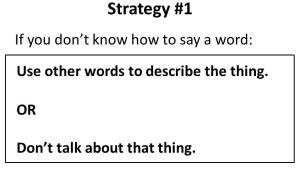
- Ask students what their biggest challenge was. Someone will say they didn’t know some of the words they wanted to use. Ask students:
“What can you do in a situation where you don’t know a word that you want to use?”
- Point to the word “fungus” and ask, “What if you didn’t know this word? What could you do?” Some students will say something like, “Describe it.” Ask students to describe “fungus” in the context of the video clip. Students will shout out: “blue part of cheese” and “stinky” and “smelly” and “rotten”, among other descriptions.
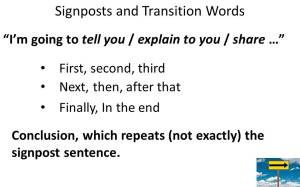
- Using Impromptu PPT Slides 7-10, show students a few strategies for impromptu speaking.


IV. Production (15 min)
- Tell students we are going to practice our new strategies with another impromptu speaking activity. Introduce the activity by showing Impromptu PPT Slides 11-12. Note that we are now aiming for 2-minute speaking times and trying to add some organization.


- Explain that the Student B’s will speak first this time, using the “Cafeteria Prompt”, and Student A’s will speak second, using the “Animal Prompt”.
- Tell students you will give them each about 1 minute to quickly jot down some notes for their speech.
- After time expires, reset the countdown timer for 2 minutes, and begin with Student B’s speech. Then do the same for Student A’s speech.
- Remind students to use a signpost sentence, transition words, and a conclusion. Encourage students to keep talking for the full time.
- Congratulate students on completing the activity.
- With the remaining 5 minutes, survey the class, asking students to share some of the info they learned about their partners (i.e. what their partner hates about the food in our cafeteria, or why their partner chose sloth as the animal they’d most like to be).
***Note: Students have now proved two things to themselves:
1) They can speak creatively about topics they haven’t spent a lot of time researching.
2) They can speak for two minutes in English without stopping – something they’ve only ever done in a rehearsed presentation, prior to today’s class.
Materials:
– Apples2Apples cards (or some collection of words/phrases)
– Class chopstick set
– Michael Bublé – Singing With A Fan Live video
– Impromptu PPT
– Blank scrap paper for note-taking
– “Lovely Bubble Bath” – 0:00-1:55
– “Artful Bean” – 3:57-5:50
 Busan Teacher