

In this humorous and playful ELL lesson, students experiment with English pronunciation and gain a deeper understanding of English phonemes. Working in pairs or solo, they write limericks that should adhere (loosely) to a well-established format that requires an ability to identify syllables and also to employ rhyme. The lesson lets students tap into their creativity and silliness, as they become authors of poems in a genre that dates back to the 19th Century.
Level: Intermediate to Advanced
Time: 50 minutes
I. WARM-UP AND PRACTICE (10-15 min)
- Introduce the concept of limericks. Give a model. Show students that the format requires a basic understanding of units of pronunciation called syllables.
- Have students practice counting syllables in a variety of words.
- The following PPT shows the flow of the warm-up:







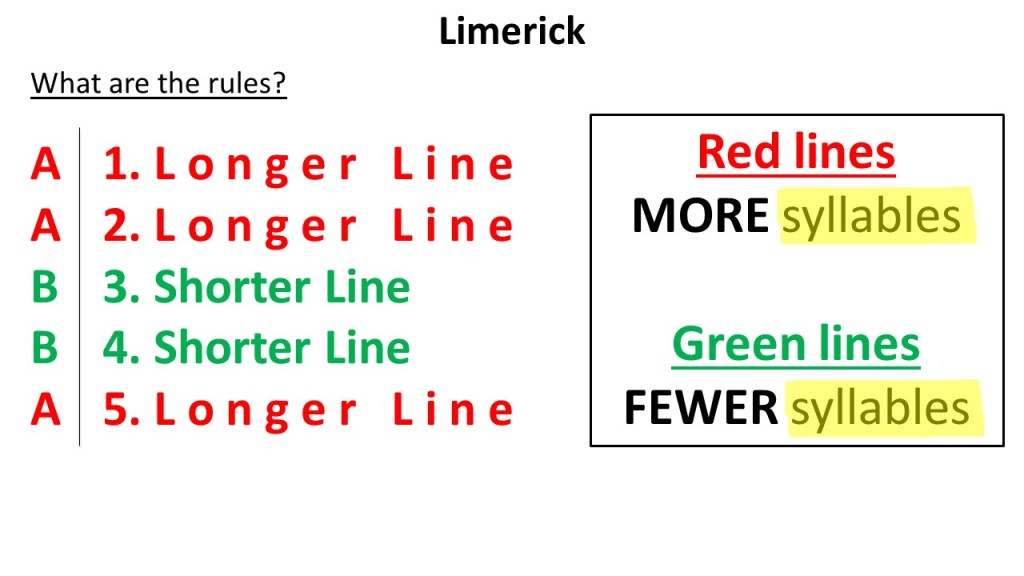


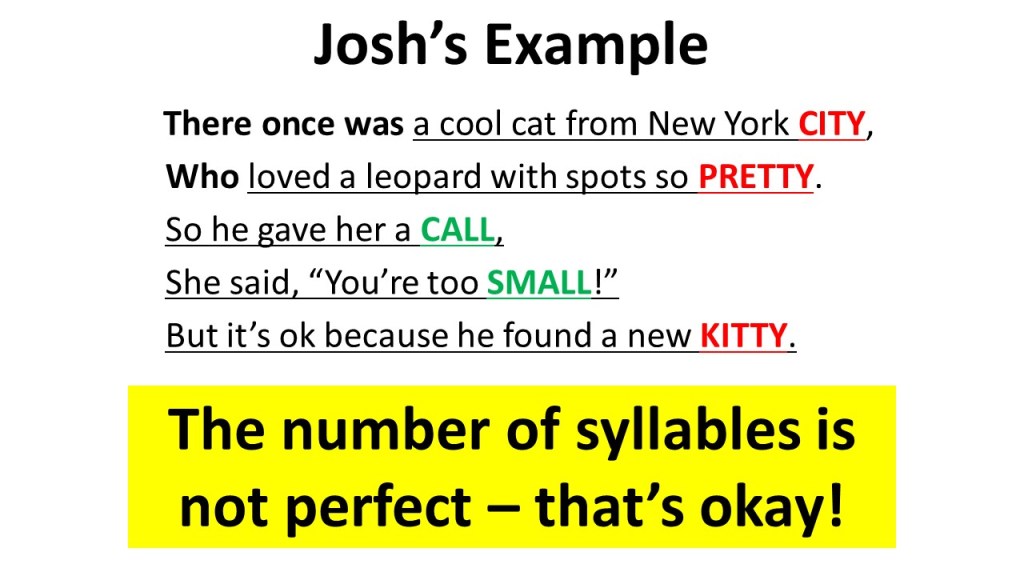

- You can be as faithful to the original syllabic structure of limericks as you want. I’m not particularly faithful. Basically I tell the students:
- Lines 1,2, and 5 are longer and rhyme with each other
- Lines 3 and 4 are shorter and rhyme with each other (but do not rhyme with Lines 1,2, and 5)

- This list of words provides good practice for counting syllables. At first, they struggle to differentiate between spelling and sound, but they always catch on quickly after practicing out loud with the first few words:

- The answers for the above list are:
- landmark (2)
- urge (1)
- trigonometry (5)
- beneficial (4)
- annual (2-3)
- proficient (3)
- inference (3)
- interference (4)
- involved (2)
- organism (4)
- After students have a firm grip on syllables, we briefly discuss rhyme. RhymeZone.com is an excellent resource for students to refer to as they work.
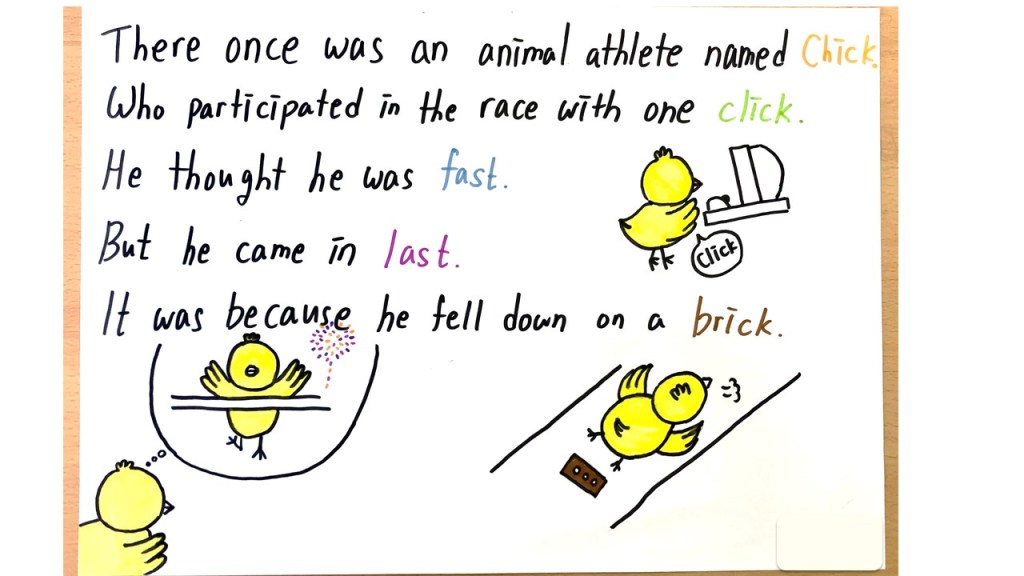
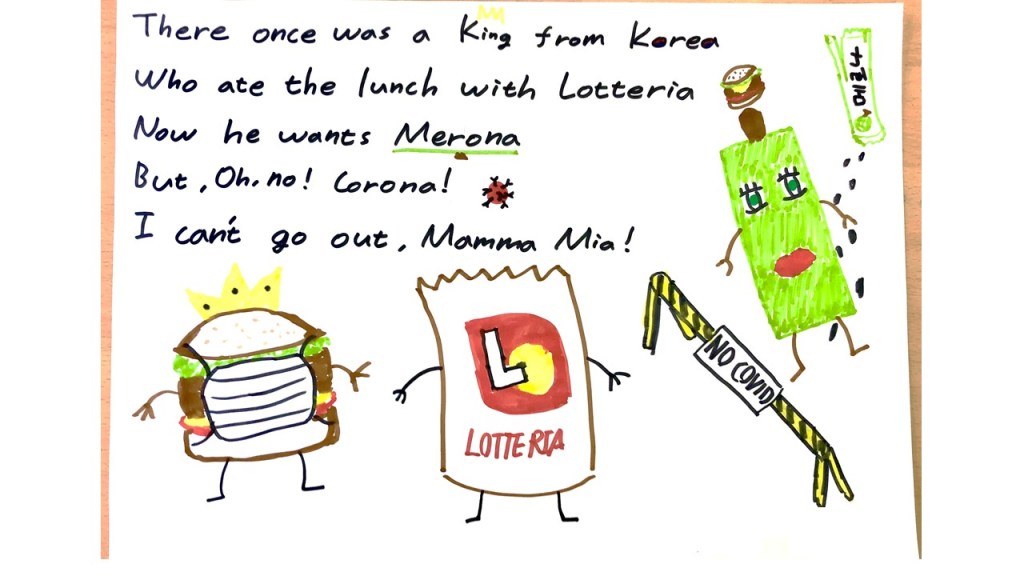
- Finally, just before students embark on writing their own limericks (in pairs usually works best), we look at some student samples:
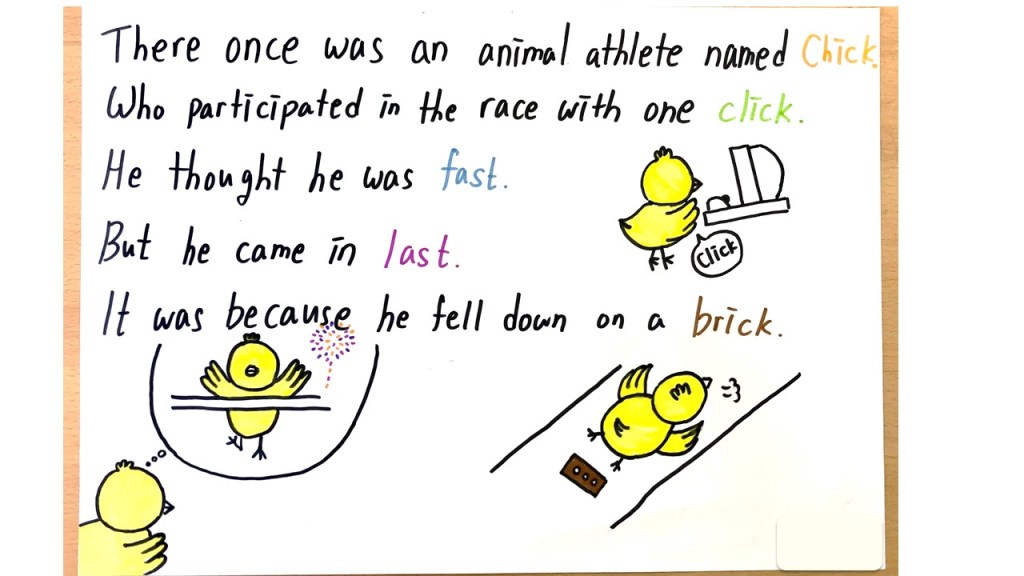


II. WRITING, ILLUSTRATING, AND SHARING (35-40 min.)
- Give each pair of students a handout for them to make the first draft of their limerick. The handout should feature two different possible structures, as seen below:

- While students are brainstorming, circulate and check understanding of syllables and rhyme. Encourage students to use their imagination – limericks don’t have to be realistic or serious.
- After students start solidifying their concepts, give them a large paper and markers to display and illustrate their limericks.
- Depending on time, level of students, and other context-specific factors, there are a number of different ways for students to share their work with other students and with the teacher.
- In our class, at the very least, I ask students to recite their final limerick in unison with their partner. It always produces laughs (and a sense of pride for having authored something that is creative and sonically pleasing).
 Busan Teacher